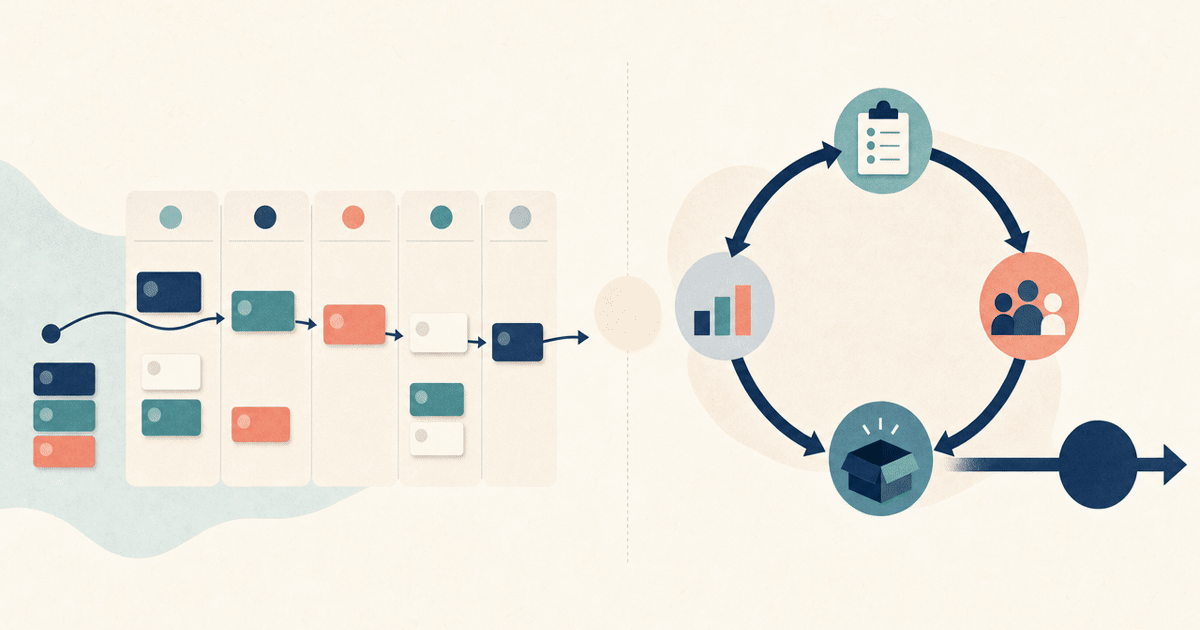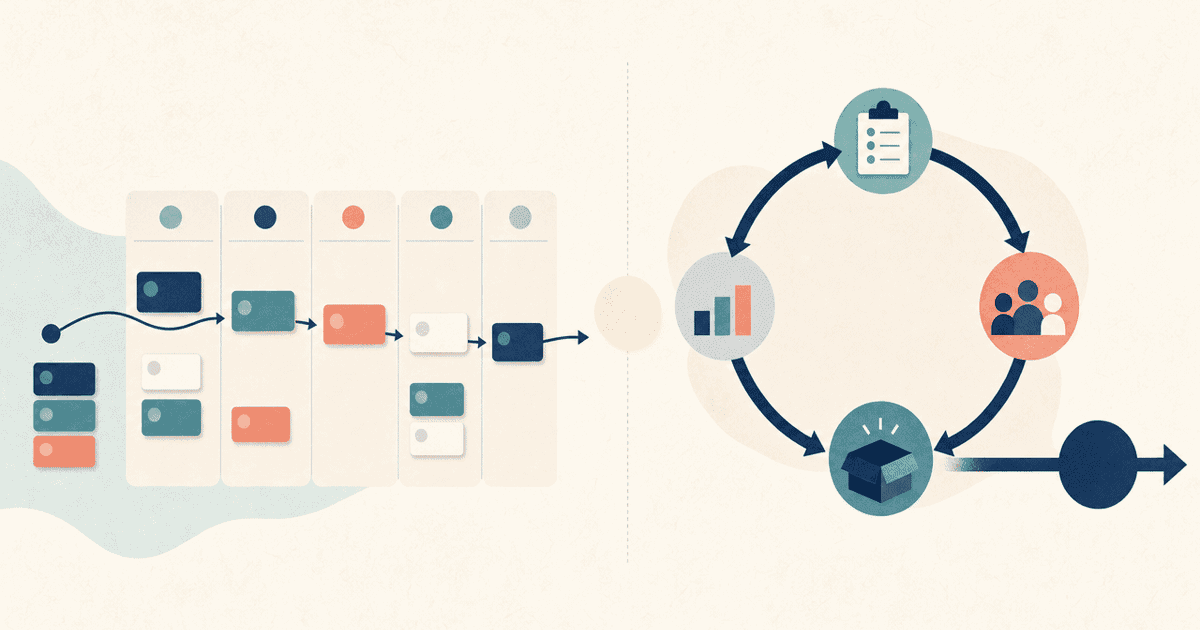
Kanban and Scrum both help teams make work visible, but they organize that work differently. Kanban uses continuous flow and work-in-progress limits, while Scrum uses fixed-length sprints and a shared Sprint Goal. Choose Kanban when work changes often, or Scrum when a fixed planning and review rhythm helps the team focus.
The choice is less about which method is better and more about how your team actually receives and finishes work. This guide compares the two approaches and gives you a small experiment for making the decision with your real backlog.
What is the practical difference between Kanban and Scrum?
Kanban is a flow-based method. The team pulls work into progress when capacity is available, moves it through visible stages, and uses limits to avoid starting more than it can finish.
Scrum is an iterative framework. The team selects work for a sprint, works toward a sprint goal, and reviews the result at the end of a fixed timebox. Scrum defines accountabilities for the Product Owner, Scrum Master, and Developers, along with events such as Sprint Planning, the Daily Scrum, Sprint Review, and Sprint Retrospective.
The Kanban Guide and the Scrum Guide describe the formal foundations. In daily work, the most visible difference is the clock: Kanban manages flow continuously, while Scrum groups planning and review around sprints.
How does work enter the system?
In Kanban, work enters when the team has capacity and the item meets the team's definition of ready. There is no requirement to wait for the next sprint boundary. A support request, bug, or small improvement can enter the flow when the team decides it is the next useful item.
In Scrum, the team and Product Owner select work during Sprint Planning. The selected items support a Sprint Goal and form the Sprint Backlog. New work can still be discussed during a sprint, but changing the sprint plan should not quietly destroy the goal.
This difference matters when priorities change often. A team handling incoming support work may find a continuous pull system easier to operate. A product team working toward a shared outcome may prefer the focus that comes from a sprint goal.
How does the team work day to day?
A Kanban team usually keeps a board open during the day and watches where work is waiting. The regular conversations can be lightweight: what should start next, what is blocked, and what can we help finish?
A Scrum team follows a more defined cycle. It plans the sprint, checks progress toward the goal in a Daily Scrum, reviews the increment with stakeholders, and reflects on the process in a retrospective. The events create useful feedback when the team uses them to make decisions rather than treating them as status reporting.
Neither method removes the need for clear cards. A card should explain the outcome and the next action. A board with unclear cards produces unclear conversations regardless of the framework.
When is Kanban the better fit?
Kanban is often a better fit when the team has a steady stream of different work rather than a predictable set of sprint-sized items.
Work arrives continuously
Support, operations, bug triage, and maintenance rarely respect a two-week boundary. Kanban lets the team make new work visible and pull it in when there is capacity.
Priorities change during the week
A Kanban board can absorb a priority change without pretending that the rest of the work is unaffected. The team can pause, finish, or replace an item and see the impact in the flow.
The team is small or still finding its rhythm
A solo developer or small team may not need formal roles and a full sprint ceremony. A board with Ready, In Progress, In Review, and Done can be enough to expose the next decision. Our kanban board examples post covers the column sets that hold up at this size, and the test for a column that is not earning its place.
You want to improve flow gradually
Kanban does not require a complete process reset. Start with the existing workflow, make it visible, and add a WIP limit to the stage where work tends to pile up. WIP limits explained covers how to choose and adjust a first limit.
When is Scrum the better fit?
Scrum can be a better fit when a stable team needs a shared planning and feedback rhythm.
The team benefits from a sprint goal
A sprint goal gives the team a short-term outcome to protect while it decides which details are most important. This can help when a product team needs focus rather than a constantly changing queue.
Product feedback arrives at regular checkpoints
Sprint Reviews give stakeholders a recurring place to inspect the increment and change direction. The feedback is most useful when the team has a real increment to show, not just a set of partially finished tickets.
The team is willing to support the framework
Scrum works poorly as a collection of calendar events that nobody uses to improve the work. The team needs to understand its accountabilities and protect the purpose of its events. Adding roles and ceremonies without changing decisions only adds overhead.
What about Kanban vs Scrum sprints?
Kanban does not require sprints. Work moves through the system continuously, and the team measures or discusses flow over a chosen period.
Scrum uses sprints as fixed-length containers for a Sprint Goal and a selected set of work. A sprint is not simply a date filter on a Kanban board. It changes how the team plans, protects focus, and reviews progress.
Some teams use a hybrid approach. They plan around a regular cadence while keeping a Kanban-style board and WIP limits. That can work when the team is explicit about which rules it is using. A hybrid process becomes confusing when it keeps the meetings from Scrum but loses the decision rules from both methods.
How should you choose a workflow?
Use the work itself as the test. Do not choose based on the label your team likes best.
Ask these questions:
- Does urgent work arrive throughout the week?
- Can the team protect a short-term goal from new requests?
- Does unfinished work usually pile up in development or review?
- Would a fixed planning rhythm help the team focus?
- Will the team use the ceremonies to make decisions?
- Is the current problem too much work in progress, unclear priorities, or missing feedback?
If incoming work is the main source of disruption, start with Kanban and make the queue visible. If the team needs a shared outcome and regular stakeholder feedback, test Scrum. If the answer changes by work type, use separate workflows rather than forcing support and product discovery into the same board.
For a small development team, Kanban for developers shows a practical flow for sprint work and bug triage. It does not require you to adopt a complete framework to get the useful parts of visual work management.
Can you test Kanban and Scrum in one week?
Yes, as long as the experiment is narrow. Keep the same real work and compare the decisions each workflow makes easier.
For the first few days, run a simple Kanban flow from Ready to Done. Limit active work and record where cards wait.
For the next few days, define one small outcome as a sprint goal. Select a small Sprint Backlog, protect the goal, and hold a short review at the end. Track interruptions and unfinished work instead of trying to calculate a perfect velocity.
At the end, compare the results:
- Which approach made the next item clear?
- Which approach handled new urgent work with less confusion?
- Where did work wait?
- Did the meetings help the team decide anything?
- Could everyone explain what was in progress and why?
The better workflow is the one that helps your team finish and learn without adding process that nobody can maintain.
Frequently asked questions
What is the main difference between Kanban and Scrum?
Kanban manages a continuous flow of work with visible stages and WIP limits. Scrum organizes work into fixed-length sprints with a Sprint Goal, defined accountabilities, and regular events. Kanban changes the flow as capacity changes, while Scrum uses the sprint cycle to create a short period of focus and review.
Is Kanban or Scrum better for small teams?
Neither is automatically better. Small teams often start with Kanban because a visible board and a few WIP limits are quick to use. Scrum can work well when the team needs a shared sprint goal and regular stakeholder feedback. Choose the smallest process that solves the team’s actual problem.
Can you use Kanban without sprints?
Yes. Kanban does not require fixed-length sprints. Work can enter and leave the system continuously as the team has capacity. You can still review flow weekly or use another cadence for planning. A review period is not the same thing as a Scrum sprint with a Sprint Goal and Sprint Backlog.
Should a team use Kanban or Scrum for bug tracking?
Kanban is often easier for bug tracking because bugs can arrive at any time and need a visible triage queue. A small flow from Inbox to Done, with a separate check for reproducibility, keeps decisions clear. Scrum can also handle bugs, but the sprint rules must protect urgent work and the Sprint Goal.
What is a Kanban and Scrum hybrid called?
Teams often use the informal term Scrumban for a process that combines parts of Scrum and Kanban. The label is less important than the rules. Define how work enters, how much can be active, when planning happens, and how the team reviews outcomes. Otherwise the hybrid keeps the ceremony without the clarity.
Conclusion
Choose Kanban when continuous flow, changing priorities, and visible bottlenecks are the main concerns. Choose Scrum when a shared sprint goal and a fixed feedback rhythm will help the team focus. If you are unsure, test both with real work for a week and compare the decisions each one makes easier.
If you are unsure how either relates to agile as a whole, kanban vs agile sorts out which question you are really asking.
The method matters less than keeping work visible, limiting unfinished tasks, and making room to improve the way the team works.