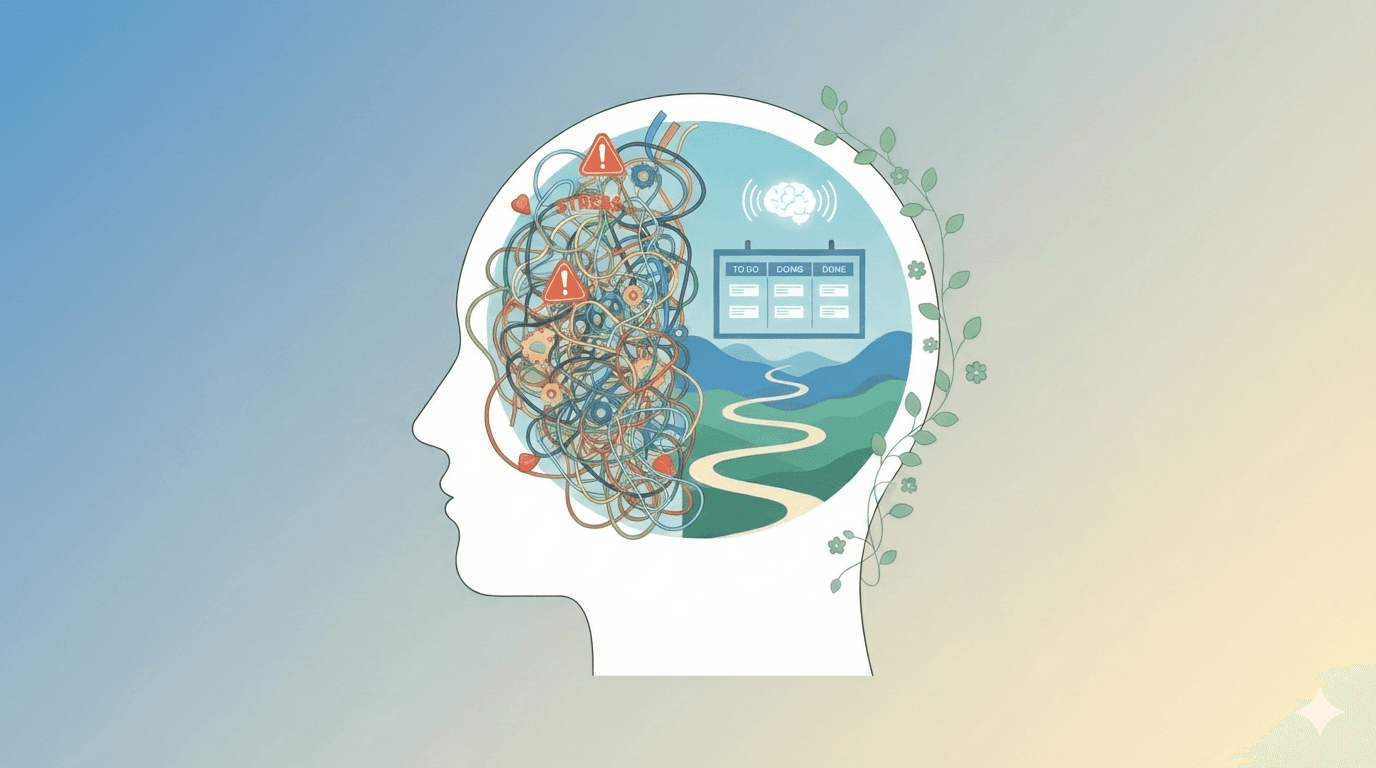
Calm productivity means keeping stress low enough that the parts of your brain responsible for planning and judgment keep working normally. That's not a mood preference. Under stress, the prefrontal cortex, the region behind decision-making and sustained focus, measurably loses capacity while the brain shifts resources toward threat response instead. The rest of this post is the specific research behind that claim, and what it changes about how you'd structure a workday.
Why switching tasks costs more than it feels like it does
The clearest, most measurable cost of a stressed, reactive workday is task switching. The American Psychological Association's review of switching-cost research attributes productivity losses of up to 40 percent to the mental "reconfiguration" a brain performs every time it drops one task and picks up another. Each individual switch costs only a fraction of a second, so the damage isn't any single switch. It comes from how often switching happens: a workday built around checking messages every few minutes accumulates dozens of these resets before lunch.
None of this means single-tasking all day is realistic. It means the switches that matter are the ones you choose, not the ones a notification chooses for you. Batching communication into two or three fixed windows, rather than leaving it open continuously, is the practical version of the finding: fewer switches, chosen on purpose.
Why an open task won't leave you alone
There's a specific reason an unfinished item nags at you during dinner while a finished one doesn't. Psychologist Bluma Zeigarnik documented in 1927 that people remember interrupted or incomplete tasks better than completed ones. The task creates a kind of standing tension that completed work doesn't.
The useful part of this research came almost a century later. In a 2011 study, psychologists E.J. Masicampo and Roy Baumeister found that this tension doesn't actually require finishing the task to go away. It requires a specific plan: when and how the task will get done. Participants who wrote a concrete plan for an unfinished goal showed the same drop in intrusive thoughts as participants who'd actually completed it. A vague intention didn't do this. A plan with a when and a how did.
This is the real argument for writing tasks down somewhere specific, rather than carrying them in your head or on a loose list titled "stuff to do." A card sitting in a column named for what happens next, not just a line in a list, is closer to the plan the study describes than to the task itself. Sorting every open task into a column called Do First, Schedule, or Delegate is one concrete version of that plan; building an Eisenhower Matrix out of kanban columns covers the specific layout.
What a card moving across a board actually does
A kanban board's mechanics map onto both findings more directly than most productivity systems, and it's worth being specific about why rather than just asserting it.
Moving a card into a column with a name like "This Week" or "Doing" is a small act of planning, not just recording. It states when the work happens, which is closer to what Masicampo and Baumeister's participants did than writing the task on an undifferentiated list. A WIP limit, capping how many cards can sit in "Doing" at once, forces the batching that reduces task-switching cost: you work through a card, not across five of them, before starting the next. And a visible "Done" column gives you a place to see finished work accumulate, which matters for a separate reason.
Teresa Amabile and Steven Kramer's research, published in Harvard Business Review after analyzing roughly 12,000 daily work diaries from 238 people, found that visible progress on meaningful work was the single strongest predictor of a good day at work, ahead of recognition, incentives, or clear goals. A column called Done that actually fills up during the week is a direct, low-effort way to make that progress visible to yourself.
Building a week around this
The three findings point at the same practical shape: fewer chosen interruptions, specific plans instead of vague intentions, and visible completion. None of it requires a complicated system.
A simple version: cap the number of cards allowed in your "Doing" column at two or three. Check messages at set times rather than continuously. At the end of each day, look at what actually moved to Done rather than at what's still sitting in Backlog. At the end of the week, clear out anything stale rather than letting it carry over silently. If you want a fuller weekly structure, 5 Ways to Organize Your Week with a Kanban Board covers five different weekly layouts and the reset that keeps any of them working past week two.
None of this depends on a specific tool. A minimal kanban board with three columns does it. So does a goal board and a daily focus board built around one rule: one thing in Doing at a time. The mechanism is the plan and the visible progress, not the software.
Frequently asked questions
What is calm productivity?
Calm productivity is working in a way that keeps stress hormones low enough that the brain's planning and decision-making regions keep functioning normally, instead of shifting resources toward threat response. It's a description of a physiological state, not a specific method or app.
Does calm productivity mean doing less work?
No. It's about how work gets structured, not how much of it there is. The research behind it (task-switching costs, the Zeigarnik effect, the progress principle) is about reducing wasted mental effort and stress, which can leave more real capacity for the work itself, not less of it.
What is the Zeigarnik effect, in plain terms?
It's the tendency to remember and keep thinking about an unfinished task far more than a finished one, first documented by psychologist Bluma Zeigarnik in 1927. A 2011 follow-up study found that writing a specific plan for the task, not finishing it, is what actually resolves the mental tension.
How many tasks should I have "in progress" at once?
There's no universal number, but two or three is a common practical limit, and it directly reduces the task-switching cost the APA's research describes. Read WIP Limits in Kanban for how to set one for your own workflow and what to do when a column fills up.
Does writing a to-do list actually reduce stress?
Only if the entries function as plans, not reminders. Masicampo and Baumeister's research found that a vague intention didn't reduce intrusive thoughts about a task, but a plan naming when and how it would get done did, about as effectively as finishing the task.
Want a calm place to hold your plans? Try EasyKanban free, a minimal kanban board with a WIP limit and a Done column built in. Three boards and unlimited cards, no account required to start.